

Surface Sizing Starch Market: Technology Evolution, Regional Demand & Forecast Scenarios to 2036
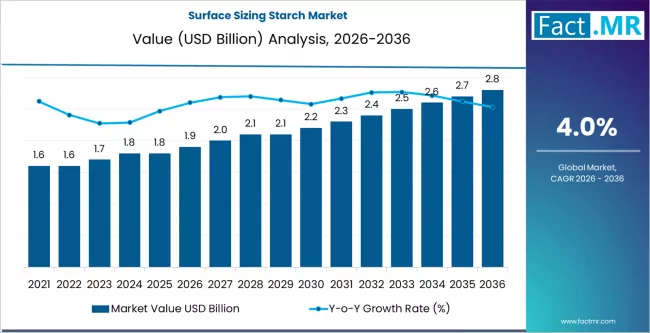
Surface Sizing Starch Market Size and Share Forecast Outlook 2026 to 2036
ROCKVILLE, MD, UNITED STATES, January 21, 2026 /EINPresswire.com/ -- The global surface sizing starch market is projected to witness steady growth over the next decade, with its valuation expected to rise from USD 1.9 billion in 2026 to USD 2.8 billion by 2036. According to specialized industry analysis, the market will expand at a compound annual growth rate (CAGR) of 4.0%, propelled by the surging demand for high-quality packaging materials and the global shift toward eco-friendly, bio-based paper additives.Surface sizing starch is a critical component in the papermaking process, applied to the surface of paper and board to improve strength, printability, and resistance to liquid penetration. As e-commerce continues to drive the demand for durable containerboard and the printing industry shifts toward high-speed digital technologies, the requirement for advanced, modified starch derivatives has reached an all-time high.
Request for Sample Report | Customize Report |purchase Full Report - https://www.factmr.com/connectus/sample?flag=S&rep_id=13712
Core Market Dynamics: Answering the Strategic ‘How’ and ‘Why’
The market is shifting from native starch toward high-performance modified starches that offer superior film-forming properties and surface holdout.
Who is leading the sector? Industry pioneers including ADM (Archer Daniels Midland), Cargill, Ingredion, Tate & Lyle, and Roquette Frères are at the forefront, leveraging advanced enzymatic and chemical modification techniques to create application-specific starch solutions.
What is the dominant product type? Modified Corn Starch commands a leading 46.0% market share. It remains the preferred source due to its established supply chain, cost-effectiveness, and optimal viscosity control compared to other botanical sources like potato or tapioca.
Where is growth most accelerated? India is emerging as a global growth leader with a 5.2% CAGR, fueled by rapid industrialization and the expansion of the domestic paper and packaging sectors. China follows with a 4.8% CAGR, supported by its massive manufacturing output and government-led sustainability initiatives.
Why is the technology shifting? The market is moving toward Sustainable Bio-Refining. Producers are increasingly specifying starch derivatives that reduce chemical oxygen demand (COD) in mill wastewater and improve "broke" recycling efficiency, aligning with global circular economy mandates.
Sector Insights: Packaging and Containerboard Drive Volume
The Packaging and Containerboard segment remains the primary engine of market growth, currently holding a 44.0% share of the total paper grade segment. The explosion of global logistics and "unboxing" culture has forced manufacturers to prioritize paper stiffness and moisture resistance, which are directly enhanced by surface sizing. Simultaneously, the Printing and Writing segment is evolving, requiring starches that minimize "dusting" and enhance ink receptivity for high-definition color printing.
"Starch is the functional backbone of modern paper engineering," the analysis states. "We are seeing a major trend where 'Holdout Performance' is the new benchmark. By ensuring that the starch remains on the surface rather than penetrating the fibers, manufacturers can achieve superior brightness and opacity while using less raw material, making it a high-efficiency solution for both cost and quality."
Key Market Trends and Strategic Outlook
1. Optimization through Cationic Modification
A significant absolute dollar opportunity lies in Cationic Surface Sizing Starches. While oxidized starches are traditional, cationic variants are gaining traction due to their superior holdout properties and ability to increase fines retention. This leads to cleaner "white water" systems and higher-strength paper products.
2. The Rise of Eco-Labeled Paper Additives
Innovation is focused on "Clean Label" industrial chemicals. As regulatory bodies in the United States (2.4% CAGR) and Europe tighten restrictions on synthetic sizing agents, bio-based starch solutions are being positioned as the primary green alternative, benefiting from their renewable nature and biodegradability.
3. Integration of Nanotechnology in Sizing
The next frontier of growth involves the incorporation of nanoparticles into starch formulations. This hybrid approach significantly increases the barrier properties of paper, potentially allowing starch-treated paper to compete with plastic films in certain food packaging applications.
Investment Perspective: A Resilient Pillar of the Bio-Economy
The surface sizing starch market represents a robust opportunity for agricultural processors and chemical firms. As global brands commit to replacing single-use plastics with paper-based alternatives, the demand for the specialty starches that make these paper products functional and durable is expected to remain a primary growth driver through 2036.
Browse Full Report : https://www.factmr.com/report/surface-sizing-starch-market
To View Related Report :
Surface Enhancement Technologies for PCR Plastics Market: https://www.factmr.com/report/surface-enhancement-technologies-for-pcr-plastics-market
Surface Protection Tapes Market: https://www.factmr.com/report/surface-protection-tapes-market
Surface Modifiers Market: https://www.factmr.com/report/2529/surface-modifiers-market
Smart Surfaces Market: https://www.factmr.com/report/smart-surfaces-market
S. N. Jha
Fact.MR
+1 628-251-1583
email us here
Legal Disclaimer:
EIN Presswire provides this news content "as is" without warranty of any kind. We do not accept any responsibility or liability for the accuracy, content, images, videos, licenses, completeness, legality, or reliability of the information contained in this article. If you have any complaints or copyright issues related to this article, kindly contact the author above.
