

CE Kitchen Cleaning Expands Commercial Kitchen Cleaning Services Across Virginia
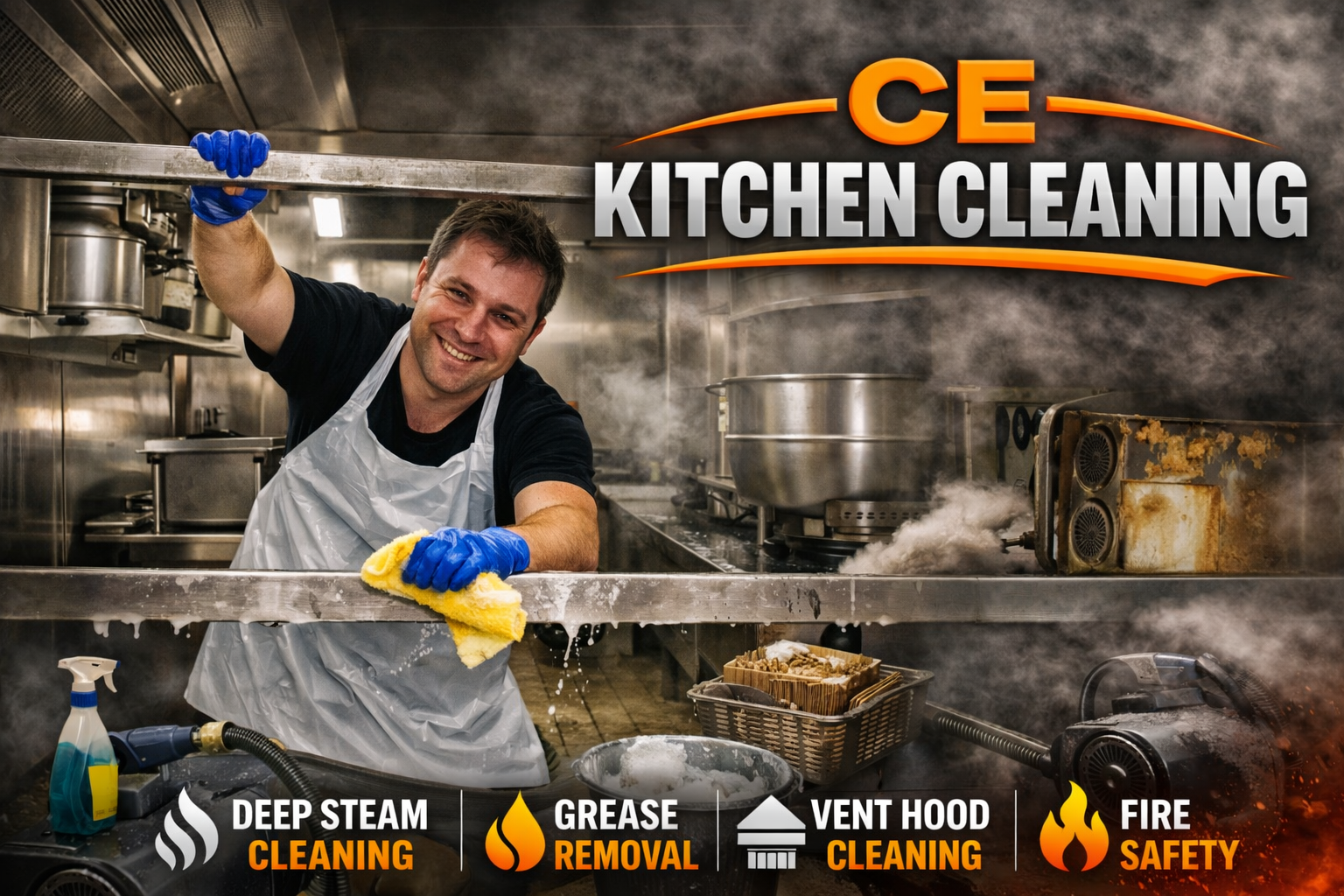
CE Kitchen Cleaning
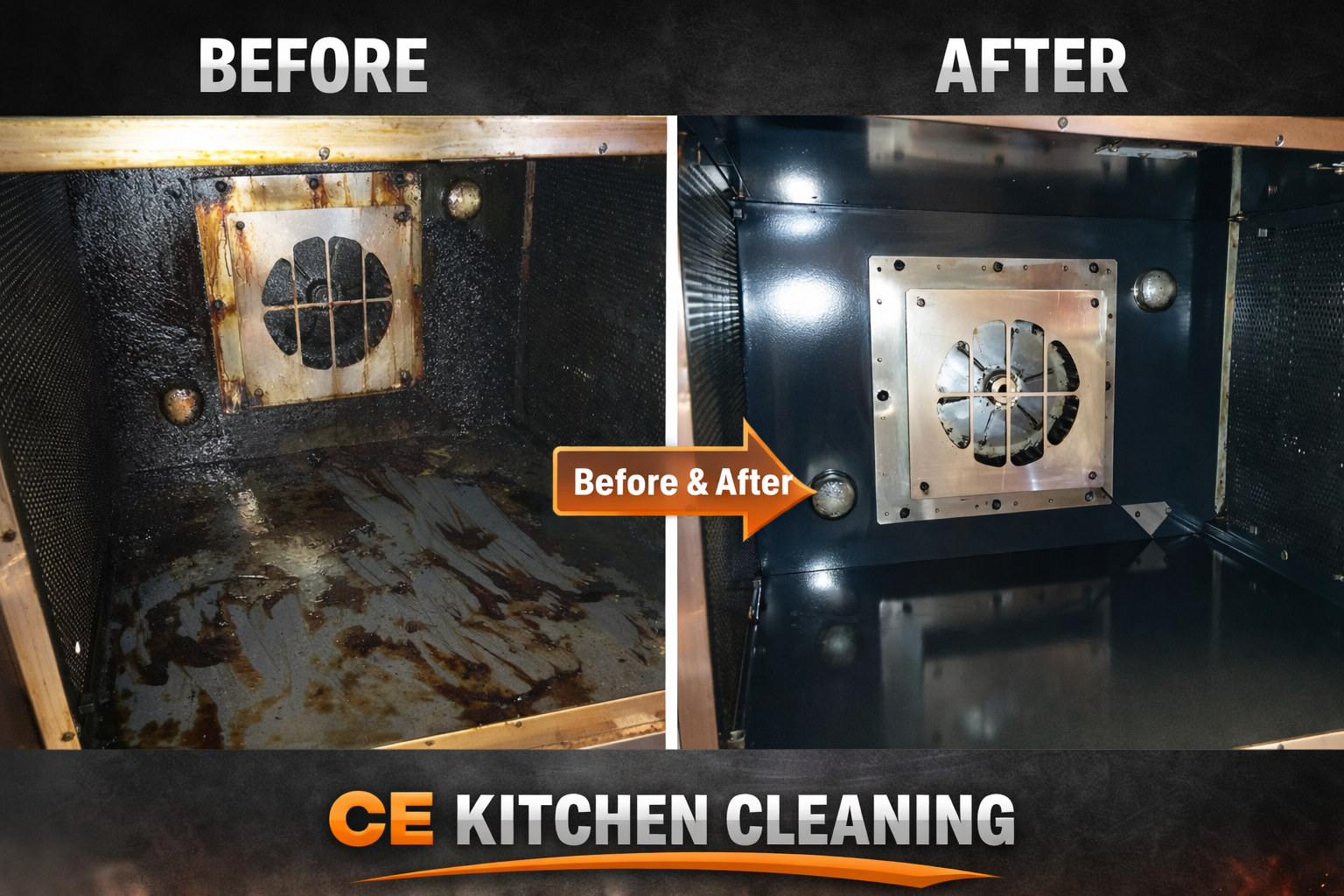
From Heavy Grease Buildup to Sanitized Surfaces: A Professional Kitchen Deep Clean
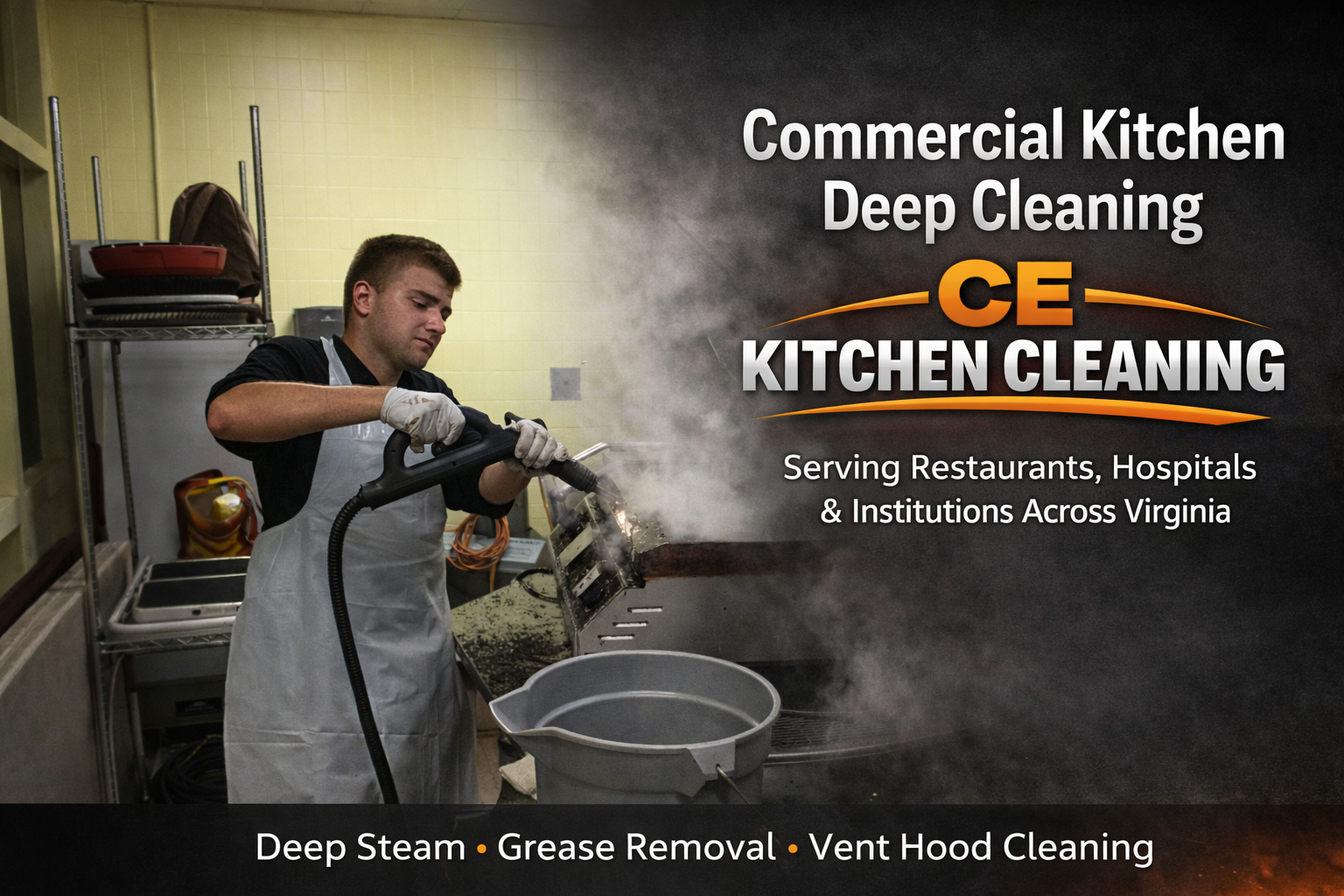
Professional Steam Sanitation Helping Commercial Kitchens Remove Grease and Bacteria

Technician Performing High-Temperature Steam Cleaning in a Commercial Kitchen
CE Kitchen Cleaning expands across Virginia, helping restaurants reduce fire risks and pass inspections with high-temperature steam sanitation.
Health inspectors are becoming more rigorous. Fire safety enforcement is intensifying. Customers are more aware of sanitation than ever before. And in an era where a single failed inspection can go viral online, kitchen hygiene is no longer just an operational concern - it’s a business survival factor.
For many restaurant owners, the challenge isn’t daily cleaning. It’s the hidden grease, bacteria, and residue that accumulate in areas staff rarely reach: behind fryers, inside ductwork, above ceiling panels, and deep within equipment.
This growing pressure is fueling demand for professional commercial kitchen cleaning services and restaurant deep cleaning services across Virginia.
One company seeing this shift firsthand is CE Kitchen Cleaning, a servicemark operated by Calamus Enterprises LLC, which has expanded its commercial kitchen deep cleaning operations throughout the state.
With more than 14 years in the industry and over 500 commercial kitchens serviced annually along the East Coast, the company specializes in high-temperature steam sanitation for restaurants, hospitals, schools, government facilities, and institutional kitchens.
The Sanitation Gap Most Kitchens Don’t See
To customers, a commercial kitchen often looks spotless. Stainless steel shines. Floors are mopped. Counters are sanitized between shifts.
But professional inspectors know where to look.
Grease vapors from cooking don’t simply disappear. They rise, condense, and settle in exhaust systems, ducts, and hard-to-reach surfaces. Sugars caramelize onto walls and equipment. Oils migrate into crevices behind appliances.
Over time, these residues form dense layers that routine cleaning cannot remove.
According to industry fire safety data, grease buildup in ventilation systems remains one of the leading causes of commercial kitchen fires nationwide. At the same time, sanitation violations frequently stem from areas invisible during daily cleaning routines.
“Most serious risks build up gradually and out of sight,” explains Mike Calamus, founder of Calamus Enterprises LLC. “By the time they become obvious, they’ve already created safety or compliance concerns.”
From Emergency Cleaning to Preventative Strategy
Historically, many operators scheduled deep cleaning only after a failed inspection or incident. That mindset is changing.
Restaurants across Virginia are increasingly adopting preventative deep cleaning as part of risk management.
Instead of reacting to violations, operators are investing in scheduled professional sanitation to:
• Reduce fire risk from grease accumulation
• Support compliance with health regulations
• Protect expensive kitchen equipment
• Improve working conditions for staff
• Safeguard brand reputation
This proactive approach is especially relevant in competitive markets like Northern Virginia, where restaurants operate on tight margins and cannot afford closures or reputational damage.
Why Steam Technology Is Gaining Popularity
Traditional chemical degreasers can be effective, but many kitchens are re-evaluating heavy chemical use due to residue concerns and ventilation issues.
CE Kitchen Cleaning https://www.steamcleaningvirginia.us/ relies primarily on high-temperature steam systems reaching up to 350°F. This allows grease breakdown and sanitation using heat instead of chemical saturation.
Professional steam cleaning can:
• Penetrate porous surfaces and tight crevices
• Dissolve hardened grease
• Sanitize without leaving chemical residue
• Use controlled moisture and suction removal
• Be safe for stainless steel and food-prep areas
For hospitals, schools, and facilities serving vulnerable populations, these methods are particularly appealing.
Supporting Virginia’s Food-Service Infrastructure
Virginia’s food-service ecosystem is vast and diverse, ranging from independent restaurants to institutional kitchens serving thousands daily.
CE Kitchen Cleaning proudly works in many regions throughout Virginia, including:
Arlington, Alexandria, Falls Church, Fairfax, Fredericksburg, Manassas, Loudoun, Prince William, Stafford, Spotsylvania, Clarke, Fauquier, Reston, Tyson’s Corner, Springfield, McLean, Burke, Annandale, Ashburn, Leesburg, Chantilly, Centreville, Sterling, and Dulles International Airport.
These areas represent some of the state’s busiest hospitality and food-service corridors.
Trusted by High-Profile Institutions
Over the years, CE Kitchen Cleaning has provided services to recognized organizations such as:
• The White House Complex
• World Bank
• Pfizer
• Sodexo
• Whole Foods
• Towson University
• Sentara Potomac Hospital
• Washington Cathedral
• Government and military dining facilities
Such clients often require strict documentation, reliability, and adherence to sanitation standards.
Growth Without Losing Local Touch
As demand increases, CE Kitchen Cleaning is investing in additional technicians and equipment. Yet the company maintains a direct-to-manager communication model rather than a centralized call center.
Clients typically speak with regional coordinators familiar with local regulations and facility types.
“We believe kitchens are too important for generic solutions,” Calamus says. “Every facility has its own layout, challenges, and schedule.”
Virginia Services: https://www.steamcleaning.us/kitchen-deep-cleaning-services-virginia/
Company Profile: https://www.calamus-enterprises.com/ce-kitchen-cleaning/
FAQ
1. How often should a commercial kitchen be deep cleaned if we already clean daily?
A lot of restaurant owners feel that daily cleaning covers everything until they move a fryer or open a duct panel and see what built up over time. Daily cleaning keeps things looking good, but grease vapor travels and settles in places nobody wipes down during a shift. It slowly sticks to vents, ceiling areas, and behind heavy equipment. That’s the kind of buildup that can trigger inspection notes or even fire concerns. Many kitchens that look spotless still bring in professionals like CE Kitchen Cleaning once a year because deep steam cleaning reaches places regular routines don’t.
2. Do restaurants really need professional kitchen deep cleaning to pass health inspections?
Most problems in kitchens don’t appear overnight. They build quietly. A lot of operators only discover how much grease accumulated after an inspection or a small incident. Preventative deep cleaning is more like maintenance than damage control. The restaurants that stay open long-term usually treat sanitation as insurance. That’s why many of them schedule CE Kitchen Cleaning before there’s ever a problem instead of after.
3. Is steam cleaning a commercial kitchen better than using chemical degreasers?
People often underestimate what high-temperature steam can do. At commercial levels, it’s not like a household steamer. The heat breaks down grease and loosens buildup that chemicals alone sometimes smear around. It also reaches into tiny seams and corners. Many Virginia kitchens prefer steam-based deep cleaning because it sanitizes without leaving strong chemical residue where food is prepared. That’s one reason companies like CE Kitchen Cleaning focus on steam systems for commercial kitchens.
4. How can I tell if my kitchen exhaust hood or ducts need deep cleaning?
That’s the tricky part. From the outside they can look fine. Inside is where grease collects. Some owners notice lingering smells or reduced airflow, but often there are no obvious signs. Inspectors and fire marshals look inside those systems for a reason. Having a professional check and deep clean them periodically is the only real way to know. CE Kitchen Cleaning gets called in a lot for exactly this — kitchens that looked clean but had hidden buildup.
5. Will commercial kitchen deep cleaning shut down my restaurant for days?
That’s a common fear, but most professional deep cleaning is scheduled around operations. Overnight work and off-days are normal. Experienced crews understand that restaurants can’t afford downtime. CE Kitchen Cleaning, for example, regularly works during closed hours so kitchens can reopen without losing service days. For many operators it ends up being less disruptive than expected.
6. Does deep cleaning a commercial kitchen really extend equipment life?
Grease and heat are a bad combination for machinery. When residue builds up, equipment runs hotter and parts wear faster. Clean equipment ventilates better and works more efficiently. It’s similar to maintaining any other machine. A lot of facility managers use periodic deep cleaning to protect investments in expensive appliances. That’s one reason institutional kitchens often work with companies like CE Kitchen Cleaning on a recurring basis.
7. Do small restaurants and cafés need commercial kitchen deep cleaning too?
Small kitchens often accumulate grease faster because everything is packed into a tight space. Food trucks and cafés can actually need deep cleaning just as much as large kitchens. It’s about usage, not size. CE Kitchen Cleaning works with everything from small operations to large facilities because the sanitation principles are the same.
8. Can professional kitchen deep cleaning remove strong kitchen odors?
Yes, because many kitchen odors don’t come from trash or food scraps. They come from old grease sitting in hidden areas, ducts, or drains. When those are properly cleaned, the air quality changes noticeably. Some restaurant owners are surprised how much fresher the kitchen feels afterward. That’s another common reason people call CE Kitchen Cleaning, not just inspections.
9. How often do most restaurants schedule commercial kitchen deep cleaning?
Many aim for once a year, but higher-volume kitchens sometimes do it more often. It depends on how much cooking happens and what type of food is prepared. Fry-heavy kitchens build grease faster. Operators who’ve been through tough inspections usually become more proactive and schedule regular deep cleaning with providers like CE Kitchen Cleaning.
10. What do health inspectors actually look for in kitchen cleanliness?
Inspectors don’t just check what’s shiny. They look at sanitation and safety in hidden areas, ventilation systems, and grease-prone zones. The kitchens that consistently pass inspections and avoid issues are usually the ones that combine daily cleaning with periodic professional deep cleaning. That’s where companies like CE Kitchen Cleaning fit in as a support partner rather than a last resort.
About CE Kitchen Cleaning
CE Kitchen Cleaning is a servicemark operated by Calamus Enterprises LLC. Founded by Mike Calamus, the company provides commercial kitchen cleaning, restaurant equipment cleaning services, and commercial kitchen equipment cleaning services across multiple states.
The team is insured, background-checked, and trained in food-service sanitation protocols. The company serves restaurants, hospitals, schools, government facilities, and food-service institutions.
Media Contact
CE Kitchen Cleaning
Calamus Enterprises LLC
8673 Hickory Ridge Ct, Springfield, VA 22153
Google Reviews
Phone/Text: 215-240-1363
Email: info@steamcleaning.us
Website: https://www.steamcleaningvirginia.us/
Marketing Team
CE Kitchen Cleaning
email us here
Legal Disclaimer:
EIN Presswire provides this news content "as is" without warranty of any kind. We do not accept any responsibility or liability for the accuracy, content, images, videos, licenses, completeness, legality, or reliability of the information contained in this article. If you have any complaints or copyright issues related to this article, kindly contact the author above.
