

Formaldehyde-Free Textile Crosslinkers Market Size, Price Evolution and Demand Forecast (2026–2036)
Stringent zero-tolerance chemical compliance standards and export-driven textile manufacturing accelerate global market transformation
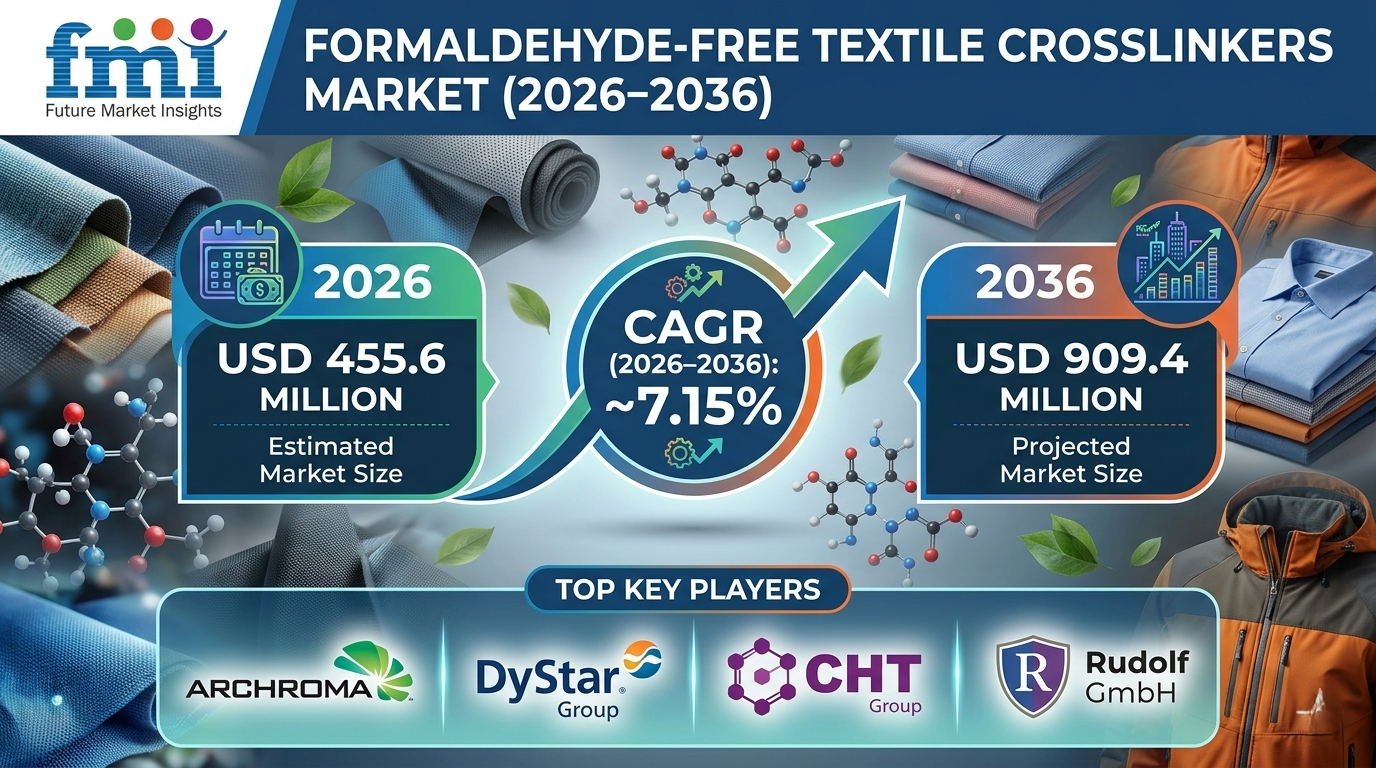
NEWARK, DE, UNITED STATES, March 24, 2026 /EINPresswire.com/ -- The global Formaldehyde-Free Textile Crosslinkers Market is valued at USD 455.6 million in 2026 and is projected to reach USD 909.4 million by 2036, expanding at a CAGR of 7.15% from 2026 to 2036. Growth is primarily driven by strict restricted substance policies enforced by Western apparel brands, compelling textile manufacturers to transition away from legacy formaldehyde-based resins to retain approved vendor status.
As global textile supply chains become increasingly compliance-driven, formaldehyde-free crosslinkers are no longer optional sustainability upgrades but essential chemical inputs required for market access. Textile mills, particularly in export-driven economies, are rapidly integrating zero-formaldehyde chemistries to meet evolving audit requirements and avoid exclusion from high-value international contracts.
Formaldehyde-Free Textile Crosslinkers Market Snapshot (2026–2036)
•Market size in 2026: USD 455.6 million
• Market size in 2036: USD 909.4 million
• CAGR (2026–2036): ~7.15%
• Leading chemistry type: Polycarboxylic Acids (PCAs)
• Top application segment: Crease resistance
• Dominant substrate: Cotton & cellulosic blends
• Fastest-growing region: Asia (led by Vietnam and Bangladesh)
• Key companies: Archroma, DyStar Group, CHT Group, Rudolf GmbH
Market Momentum
The market begins at USD 455.6 million in 2026, supported by mandatory compliance shifts across global apparel supply chains. Between 2027 and 2030, accelerated replacement of formaldehyde-based resins in tier-1 export mills drives steady adoption.
By 2032 and beyond, advancements in catalyst systems and improved curing efficiency reduce operational barriers, further strengthening market penetration. By 2036, the market reaches USD 909.4 million, as zero-formaldehyde crosslinkers become the global baseline standard in textile finishing operations.
Request For Sample Report | Customize Report |purchase Full Report - https://www.futuremarketinsights.com/reports/sample/rep-gb-32320
Why the Market is Growing
The Formaldehyde-Free Textile Crosslinkers Market is expanding due to the structural shift in procurement priorities within the textile industry. Compliance with zero-tolerance chemical standards has become a prerequisite for participating in global apparel supply chains.
Western brands, facing increasing legal and reputational risks, enforce strict chemical usage policies that require mills to eliminate formaldehyde-based inputs entirely. This dynamic shifts purchasing decisions from cost optimization to compliance necessity.
Additionally, consumer advocacy and certification frameworks are reinforcing demand for verifiable non-toxic textile processing. As a result, mills must adopt compliant chemistries despite higher energy costs associated with elevated curing temperatures.
Segment Spotlight
1. Chemistry Type: Polycarboxylic Acids Lead Demand
Polycarboxylic acids account for approximately 42.5% of the market share in 2026, driven by their compatibility with existing textile finishing infrastructure. Their ability to integrate into traditional pad-dry-cure processes without major equipment modifications makes them the preferred choice among mill operators.
2. Application: Crease Resistance Dominates
Crease resistance holds around 38.2% of demand, as it is critical for maintaining garment durability and appearance. Crosslinking agents enable fabrics to retain shape and resist wrinkling, particularly in cotton-based apparel.
3. Substrate Type: Cotton & Cellulosic Blends Lead
Cotton and cellulosic blends represent approximately 55.4% of the market, as these materials require chemical crosslinking to achieve dimensional stability and durability during repeated washing cycles.
Drivers, Opportunities, Trends, Challenges
• Drivers: Zero-tolerance compliance mandates, export market dependency, consumer safety concerns
• Opportunities: Low-temperature catalyst innovation, compliance tracking systems, customized formulations
• Trends: Qualification-driven procurement, integration of chemical traceability, shift to engineered finishing solutions
• Challenges: High curing temperatures, increased energy costs, variability in catalyst performance
Country Growth Outlook (2026–2036)
Vietnam leads with a projected CAGR of 9.2%, driven by strong integration with North American apparel supply chains. Bangladesh follows at 8.9%, supported by large-scale cotton apparel production. India grows at 8.5%, benefiting from both domestic demand and export opportunities. China records 8.1% growth amid regulatory tightening, while Germany (7.8%), Turkey (7.5%), and the United States (6.2%) show steady expansion.
Competitive Landscape
The market is highly competitive, with key players focusing on catalyst innovation, technical service integration, and process optimization. Companies such as Archroma and DyStar Group maintain strong positions by embedding technical expertise directly within textile finishing operations.
Competition is increasingly centered on delivering consistent performance, reducing curing temperatures, and supporting mills in achieving compliance without compromising productivity. Proprietary catalyst systems and application-specific formulations are becoming key differentiators.
Frequently Asked Questions (FAQ)
What is the global Formaldehyde-Free Textile Crosslinkers Market size?
The market is valued at approximately USD 455.6 million in 2026 and is projected to reach USD 909.4 million by 2036.
At what rate is the market expected to grow?
The market is forecast to expand at a CAGR of about 7.15% from 2026 to 2036.
What are formaldehyde-free textile crosslinkers?
They are chemical agents used in textile finishing that create durable bonds within fibers without releasing formaldehyde, ensuring compliance with global safety standards.
Why are these crosslinkers gaining importance?
They enable textile manufacturers to meet strict compliance requirements, maintain access to global markets, and align with consumer demand for safe, non-toxic apparel.
Explore More Related Studies Published by FMI Research:
CO2 Reduced Concrete Market: https://www.futuremarketinsights.com/reports/co2-reduced-concrete-market
Marine Waste-Derived PCR Plastics Market: https://www.futuremarketinsights.com/reports/marine-waste-derived-pcr-plastics-market
Hybrid PCR and Bio-Resin Polymer Market: https://www.futuremarketinsights.com/reports/hybrid-pcr-and-bio-resin-polymer-market
About Future Market Insights (FMI)
Fture Market Insights, Inc. (FMI) is an ESOMAR-certified, ISO 9001:2015 market research and consulting organization, trusted by Fortune 500 clients and global enterprises. With operations in the U.S., UK, India, and Dubai, FMI provides data-backed insights and strategic intelligence across 30+ industries and 1200 markets worldwide.
Why Choose FMI: https://www.futuremarketinsights.com/why-fmi
Sudip Saha
Future Market Insights Inc.
+1 347-918-3531
rahul.singh@futuremarketinsights.com
Legal Disclaimer:
EIN Presswire provides this news content "as is" without warranty of any kind. We do not accept any responsibility or liability for the accuracy, content, images, videos, licenses, completeness, legality, or reliability of the information contained in this article. If you have any complaints or copyright issues related to this article, kindly contact the author above.
