

Optical Whitening Agents Market to Reach USD 6.0 Billion by 2036, Led by Asia Pacific with BASF & Clariant Driven Growth
optical whitening agents market
Optical whitening agents market to hit USD 6.0B by 2036 at 4.5% CAGR, driven by textiles, detergents, and eco-friendly formulation innovations.
NEWARK, DE, UNITED STATES, April 1, 2026 /EINPresswire.com/ -- The global Optical Whitening Agents (OWA) Market is valued at USD 3.87 billion in 2026 and is projected to reach USD 6.00 billion by 2036, expanding at a CAGR of 4.50% during the forecast period. Growth is supported by increasing textile production, rising detergent performance standards, and expanding applications in paper, plastics, and coatings industries.
As industries increasingly focus on enhancing product aesthetics and visual appeal, optical whitening agents are becoming essential additives in manufacturing processes. Their ability to convert ultraviolet light into visible blue-white fluorescence enhances perceived brightness, positioning them as critical components in modern industrial formulations.
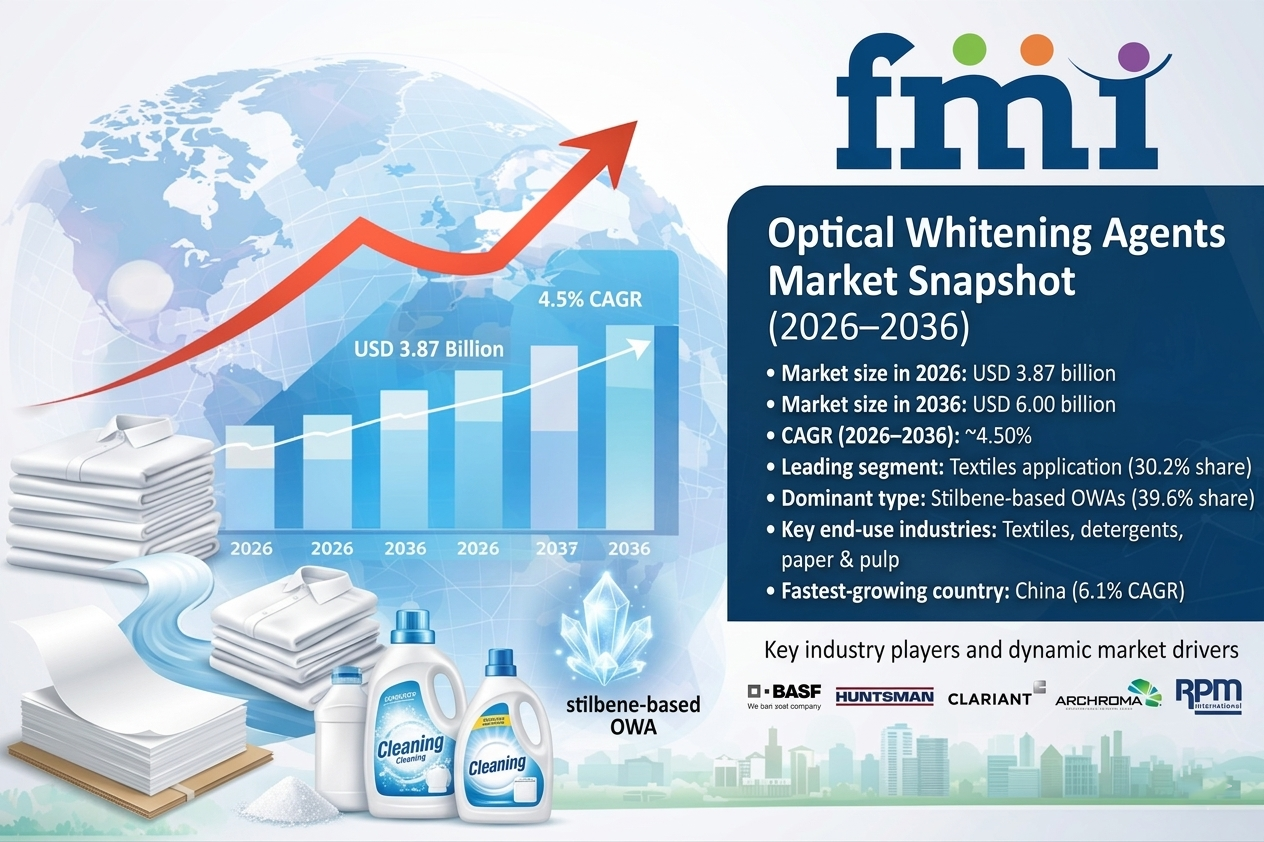
Optical Whitening Agents Market Snapshot (2026–2036)
• Market size in 2026: USD 3.87 billion
• Market size in 2036: USD 6.00 billion
• CAGR (2026–2036): ~4.50%
• Leading segment: Textiles application (30.2% share)
• Dominant type: Stilbene-based OWAs (39.6% share)
• Key end-use industries: Textiles, detergents, paper & pulp
• Fastest-growing country: China (6.1% CAGR)
• Key companies: BASF, Huntsman, Clariant, Archroma, RPM International
Market Momentum
The optical whitening agents market begins at USD 3.87 billion in 2026, driven by strong consumption in textile finishing and detergent manufacturing. Between 2027 and 2030, increased global textile output and innovations in chemical formulations are expected to accelerate market adoption.
By 2032 and beyond, regulatory-driven reformulation and advancements in eco-friendly OWA chemistries will reshape the competitive landscape. Manufacturers are focusing on improving photostability, reducing environmental impact, and enhancing fluorescence efficiency.
By 2036, the market is projected to reach USD 6.00 billion, supported by widespread adoption across textiles, paper, plastics, and specialty applications.
Request For Sample Report | Customize Report | Purchase Full Report
https://www.futuremarketinsights.com/reports/sample/rep-gb-5638
Why the Market is Growing
The Optical Whitening Agents market is expanding steadily due to rising demand for visually appealing and high-quality products across industries. In textiles, OWAs play a critical role in achieving brightness standards required by global apparel brands. With global textile production exceeding 120 million metric tonnes annually, demand for whitening agents continues to rise significantly.
In the detergent sector, manufacturers rely on stilbene-based OWAs to deliver visible whitening performance that meets consumer expectations. These agents enhance fabric appearance even after multiple wash cycles, reinforcing their importance in product formulations.
Additionally, the paper and pulp industry utilizes optical brighteners to achieve high brightness levels without increasing bleaching costs. This contributes to operational efficiency while maintaining product quality.
Environmental regulations such as REACH and EPA guidelines are also influencing the market, encouraging the development of low-ecotoxicity formulations. This shift is driving innovation and creating new growth opportunities for sustainable chemical solutions.
Segment Spotlight
1. Application: Textiles Lead Market Share
The textiles segment accounts for approximately 30.2% of the market, driven by high consumption in fabric finishing processes. OWAs enhance brightness, improve color consistency, and maintain fabric quality across applications.
2. Type: Stilbene Dominates
Stilbene-based optical whitening agents hold around 39.6% share, owing to their superior fluorescence efficiency, photostability, and compatibility with multiple substrates such as textiles, plastics, and paper.
3. Application Expansion: Detergents and Paper
Detergents and paper industries collectively represent a significant share, supported by increasing demand for high-performance cleaning solutions and premium paper products.
Drivers, Opportunities, Trends, Challenges
• Drivers: Rising textile production, demand for enhanced aesthetics, growth in detergent formulations
• Opportunities: Development of eco-friendly OWAs, advanced chemical formulations, emerging markets growth
• Trends: Shift toward low-toxicity agents, improved photostability, innovation in fluorescence technologies
• Challenges: Regulatory scrutiny on chemical compositions, environmental concerns, raw material constraints
Country Growth Outlook (2026–2036)
China leads the market with a CAGR of 6.1%, driven by its dominance in textile manufacturing and detergent production. India follows at 5.6%, supported by expanding industrial and consumer markets. Germany (5.2%) and Brazil (4.7%) show stable growth due to industrial demand and technological advancements.
The United States (4.3%) and the United Kingdom (3.8%) maintain steady expansion, while Japan records a moderate growth rate of 3.4%, reflecting mature market conditions.
Competitive Landscape
The Optical Whitening Agents market is characterized by the presence of global chemical manufacturers focusing on innovation, sustainability, and product performance. Key players such as BASF, Huntsman, Clariant, and Archroma are investing in advanced chemical formulations and environmentally compliant solutions.
Competition is increasingly centered on enhancing fluorescence efficiency, reducing environmental impact, and improving cost-effectiveness. Strategic initiatives include R&D investments, expansion of production capacities, and strengthening distribution networks in high-growth regions.
Frequently Asked Questions (FAQ)
What is the global Optical Whitening Agents Market size?
The market is valued at USD 3.87 billion in 2026 and is projected to reach USD 6.00 billion by 2036.
What is the expected growth rate?
The market is expected to grow at a CAGR of 4.50% from 2026 to 2036.
What are optical whitening agents?
They are fluorescent chemicals that absorb ultraviolet light and emit visible blue-white light to enhance brightness and whiteness.
Why are OWAs widely used?
They improve product aesthetics, enhance visual appeal, and are essential in textiles, detergents, and paper industries.
Explore More Related Studies Published by FMI Research (Chemical & Materials)
Thermoelectric Fiber & Yarn Systems for Wearable Power Market
https://www.futuremarketinsights.com/reports/thermoelectric-fiber-and-yarn-systems-for-wearable-power-market
Haptic Feedback Yarns Market
https://www.futuremarketinsights.com/reports/haptic-feedback-yarns-market
Busbar Insulation & Thermal Management Materials Market
https://www.futuremarketinsights.com/reports/busbar-insulation-and-thermal-management-materials-market
About Future Market Insights (FMI)
Future Market Insights, Inc. (FMI) is an ESOMAR-certified and ISO 9001:2015 market research and consulting organization trusted by Fortune 500 companies and global enterprises. With a strong presence across the U.S., UK, India, and Dubai, FMI delivers data-driven insights across more than 30 industries and 1,200 markets worldwide.
Why Choose FMI
https://www.futuremarketinsights.com/why-fmi
Sudip Saha
Future Market Insights Inc.
+1 347-918-3531
rahul.singh@futuremarketinsights.com
Legal Disclaimer:
EIN Presswire provides this news content "as is" without warranty of any kind. We do not accept any responsibility or liability for the accuracy, content, images, videos, licenses, completeness, legality, or reliability of the information contained in this article. If you have any complaints or copyright issues related to this article, kindly contact the author above.
