

Flat Glass Market to Near $119,140 Million by 2035 as Solar Super cycle and Green Building Codes Reshape the Industry
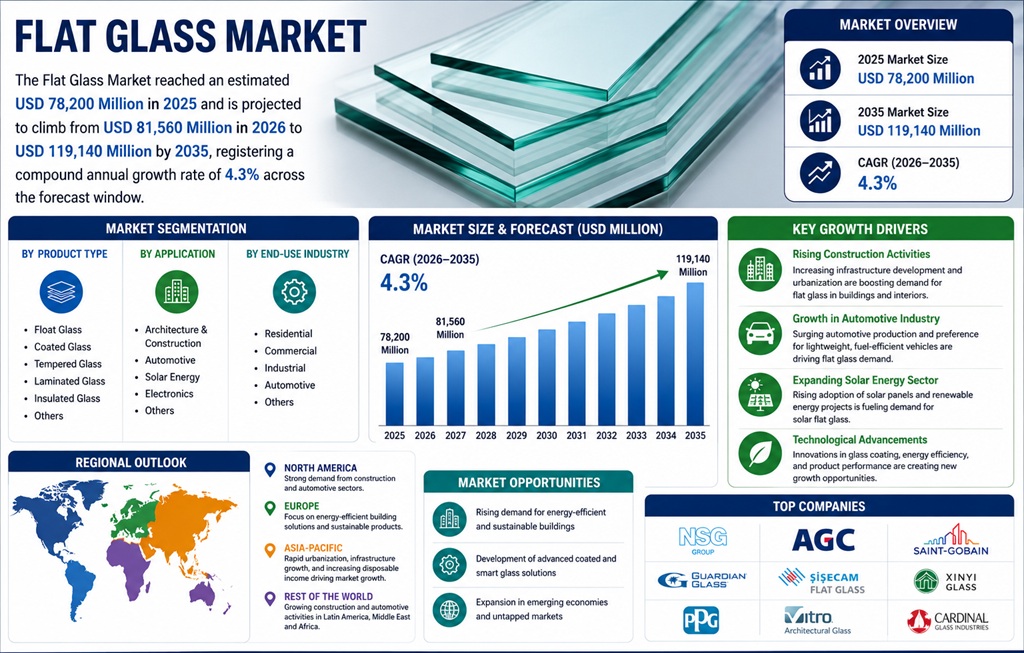
Flat Glass Market
North America is poised for a 4.1% CAGR, catalyzed by IRA-linked clean-energy manufacturing incentives and commercial building modernization.
OR, UNITED STATES, July 14, 2026 /EINPresswire.com/ -- According to a comprehensive report by Market Research Future (MRFR), the global flat glass market reached an estimated USD 78,200 million in 2025 and is projected to grow from USD 81,560 million in 2026 to USD 119,140 million by 2035, registering a compound annual growth rate of 4.3%. This expansion is being driven by three converging forces: tightening building energy performance directives that are mandating high-performance glazing at unprecedented scale, a solar photovoltaic deployment supercycle that is pulling glass producers deep into the renewable energy value chain, and the electrification of transport that is creating new functional requirements for automotive glazing.The Green Building Revolution: Regulation as Market Architect
The single most powerful driver of the flat glass market is the global tightening of building energy performance standards. The European Union's recast Energy Performance of Buildings Directive (Directive 2024/1275) mandates that all new public buildings achieve zero-emission status by 2028, extending to all new properties by 2030. Member states must renovate the 16% worst-performing non-residential stock by 2030, directly accelerating massive commercial demand for high-performance structural architectural glazing and advanced energy-efficient building envelopes.
In the United States, the Department of Energy's updated commercial building envelope standards and the Inflation Reduction Act's clean-energy manufacturing incentives are channeling capital into high-performance glazing. Canada's updated National Building Code targets a 30% reduction in building energy intensity by 2030, boosting demand for high-performance glazing in both new construction and the federal retrofit program. These regulations do not merely encourage better windows; they compel them, creating a structural demand floor that conventional single-pane glass cannot meet.
The impact is visible in product mix. Single-pane retrofit stock in developed economies is being replaced with ultra-thin triple-glazed assemblies and vacuum-insulated panels, strengthening the connection between product innovation and regulatory compliance. Low-emissivity coatings, solar-control metallic films, and self-cleaning photocatalytic layers each address distinct regulatory and performance mandates, making coated glass a bellwether for the market's value-over-volume transition. Coated glass products captured around USD 7,820 million in 2025, underpinned by these green building codes.
Download Report Sample Copy with TOC: https://www.marketresearchfuture.com/sample_request/5415
The Solar Supercycle: Glass as a Renewable Energy Enabler
The second major demand pillar is the explosive expansion of solar photovoltaic capacity. According to the International Energy Agency, global renewable capacity will expand by 4,600 GW by 2030, with solar PV accounting for roughly 80% of this growth. This unprecedented manufacturing and deployment surge exponentially increases industrial consumption of solar-grade flat glass, which remains critically essential for protective crystalline-silicon solar module cover sheets and heavy-duty protective structural backplane assemblies.
The solar glass segment is advancing at a 7.0% CAGR, the fastest sub-segment in the flat glass market, tracking global photovoltaic capacity expansion. China's solar glass producers—Xinyi Solar, Flat Glass Group, and IRICO—have collectively added over 15,000 tons per day of capacity since 2021, and expansion plans through 2028 remain aggressive. The architectural shift toward bifacial modules, which require glass on both front and rear surfaces, roughly doubles glass content per panel compared to traditional backsheet modules, meaningfully accelerating the solar segment's contribution to overall market growth.
The IEA estimates that annual solar PV additions must increase significantly to reach roughly 6,700 GW of cumulative global capacity by 2030 under clean energy pathways. This rapid deployment creates an expansive demand channel for specialized, high-transmittance, and anti-reflective protective flat glass architectures required to maximize crystalline-silicon solar module output efficiency. For flat glass producers, solar is no longer a niche application; it is becoming a core revenue stream.
Automotive Transformation: Lightweighting and Panoramic Glazing
The electrification of transport is reshaping automotive glazing demand. Data from the IEA Global EV Outlook reveals that electric vehicle adoption is rising rapidly, with the share of electricity used in transport projected to reach 6% by 2030. To optimize driving range, automotive manufacturers require specialized, thinner, acoustically laminated safety glass and expansive panoramic roofs, maximizing surface area while reducing overall curb weight.
Automotive lightweighting and EV adoption contribute approximately +0.5% to the market's CAGR, a medium-term driver that is gaining momentum as EV sales accelerate. Each electric vehicle consumes more glass per unit than conventional internal combustion vehicles, driven by larger windscreens, panoramic roofs, and battery-thermal management glazing. The segment generated USD 10,170 million in 2025 and is projected to grow steadily as OEMs expand EV platforms globally.
Decarbonization of Manufacturing: The Furnace Revolution
A structural change is redefining manufacturing floors in the flat glass market. Oxy-electric hybrid melting lines and green-hydrogen-fired units, which can reduce scope-one emissions by up to 40%, are replacing legacy regenerative furnaces that have long been the foundation of mass manufacturing. The necessity of this shift was demonstrated by Saint-Gobain alone, which set aside EUR 1.3 billion for capital expenditures related to decarbonization until 2028.
The EU's Carbon Border Adjustment Mechanism (CBAM), entering full implementation by 2026, adds a carbon cost to glass imported into the EU from jurisdictions without equivalent carbon pricing. Exporters in China and Turkey face an estimated EUR 15–25 per ton surcharge, forcing structural market adjustments and accelerating substantial capital expenditure requirements for smaller, vulnerable manufacturing operators attempting to transition away from traditional fossil-fueled melting processes. This regulatory pressure is simultaneously a challenge for laggards and an opportunity for leaders who have already invested in low-carbon production.
The circular economy is reinforcing this transition. Utilizing recycled glass—cullet—significantly improves manufacturing sustainability, as every 10% increase in cullet raw material input decreases furnace melting energy consumption by roughly 2.5% to 3.0%. Leading producers routinely incorporate 25–30% cullet without performance degradation, reducing both raw material usage and industrial processing emissions.
Purchase Now: https://www.marketresearchfuture.com/checkout?currency=one_user-USD&report_id=5415
Product and Segment Dynamics
Annealed glass accounted for roughly 74% of total flat glass market volume in 2025, reflecting its foundational role in standard architectural and automotive glazing. It serves as both a finished product for basic glazing and the feedstock for downstream processing into toughened, laminated, and coated variants. Its dominant share reflects the sheer scale of standard residential and commercial fenestration globally.
Processed glass is forecast to post a 5.0% CAGR through 2035, as demand for safety-rated and performance-enhanced products accelerates in commercial construction. Tightening safety regulations—particularly the EU's EN 12600 impact-resistance standard and updated U.S. building codes requiring safety glazing in hazardous locations—are driving specification upgrades that convert annealed demand into processed volumes.
Coated glass is the segment most directly influenced by energy-code evolution, capturing around USD 7,820 million in 2025. Low-emissivity coatings, solar-control metallic films, and self-cleaning photocatalytic layers each address distinct regulatory and performance mandates.
Solar glass stands as the breakout growth story with a 7.0% CAGR, reflecting both the sheer scale of global PV deployment targets and the architectural shift toward bifacial modules.
By end-user industry, building and construction represented 75% of the market in 2025, driven by new residential starts in Asia and deep-renovation mandates in Europe. Automotive generated USD 10,170 million, while solar glass is the fastest-growing end-user segment. Other end-user industries—including furniture, electronics, and appliances—are advancing at a 3.1% CAGR.
Regional Dynamics: Asia-Pacific Dominates, All Regions Expand
Asia-Pacific commands roughly 59% of global flat glass market revenue, the largest regional share, and simultaneously leads growth with a projected 5.0% CAGR through 2035. China's dominance is structural: the country hosts over 1.2 billion weight cases of annual flat glass capacity, supplying both domestic consumption and a substantial export pipeline to Southeast Asia, the Middle East, and Africa. China alone contributes over 54% of regional demand, with Zhejiang and Jiangsu provinces hosting the majority of worldwide solar glass production capacity.
India's trajectory stands out within the region. The government's target of 20 million urban housing units, combined with a commercial real estate boom in Tier-2 cities, is attracting capacity investments from Hindustan National Glass and multinational entrants alike. India's 5.8% CAGR is driven by the PM Awas Yojana housing program and accelerating infrastructure development. Japan contributes USD 3,410 million through seismic retrofit glazing demand, while South Korea's Green New Deal building standards sustain a 4.4% CAGR. The ASEAN bloc, valued at USD 4,670 million, benefits from infrastructure corridor investments across Indonesia, Thailand, and Vietnam.
Europe holds the second-largest share at approximately 19% of global revenue, driven by stringent near-zero-energy construction regulations and renovation-wave funding. Germany anchors regional demand at 24% of regional share through stringent KfW efficiency standards and a robust commercial real estate sector. The UK's Future Homes Standard mandates and 3.9% CAGR reflect packaging inks and decorative paints demand, while France's MaPrimeRénov' renovation subsidies drive a USD 2,380 million market. Italy's Superbonus building incentive extensions sustain a 3.7% CAGR, and the Nordic countries lead in near-zero-energy building adoption at 4.2% CAGR.
North America is poised for a 4.1% CAGR, catalyzed by IRA-linked clean-energy manufacturing incentives and commercial building modernization. The United States dominates with 72% of regional share, where Inflation Reduction Act provisions incentivize domestic solar module manufacturing, pulling solar-grade flat glass into the North American supply chain. Canada's 4.5% CAGR reflects National Building Code energy updates, while Mexico's USD 1,290 million market is driven by nearshoring-driven industrial construction.
South America holds 5.6% of global share, with Brazil dominating at 58% of regional share through the Minha Casa Minha Vida housing program, which delivered over 1.8 million units between 2020 and 2024. The region's glass industry remains heavily import-dependent outside Brazil, creating an opportunity for local float-line investment as logistics costs rise.
The Middle East & Africa is advancing at a 3.8% CAGR, driven by mega-projects and new float-line commissioning. Saudi Arabia accounts for 31% of regional share through NEOM and Vision 2030 developments that require advanced glazing for extreme-climate performance. Egypt's commissioning of its first domestic float glass line by Şişecam in 2023 marks a regional shift toward localized production, reducing reliance on Turkish and Chinese imports.
Headwinds: Energy Costs, Substitution, and Overcapacity
The flat glass market faces persistent challenges. Volatile energy and raw material costs remain the most significant headwind, as natural gas accounts for over 25% of flat glass thermal production inputs. Prolonged fluctuations in regional wholesale energy spot markets compress operating margins for mid-tier manufacturing facilities, limiting capital availability for scaling advanced industrial capacity.
Report Summary: https://www.marketresearchfuture.com/reports/flat-glass-market-5415
Competitive Landscape
The flat glass market operates at medium concentration, with the top five producers—AGC, NSG, Saint-Gobain, Guardian, and Xinyi—collectively controlling an estimated 45–52% of global revenue. The sector's capital intensity and furnace-scale economics create meaningful barriers to entry, yet regional fragmentation persists as local producers serve domestic construction markets with cost-competitive standard products. Consolidation activity is accelerating, particularly in coated and processed glass segments where technology differentiation supports margin expansion.
AGC Inc. leads with an estimated 10–13% revenue share, distinguished by global leadership and vertically integrated coatings technology. The company officially joined the Glass Futures consortium in December 2024, entering a strategic initiative to develop and scale low-carbon, sustainable manufacturing technologies for industrial float glass production lines.
Saint-Gobain captures 9–12% through its broad building-materials portfolio and decarbonization leadership. The company set aside EUR 1.3 billion for decarbonization capex through 2028 and finalized strategic acquisitions of FOSROC and Cemix in February 2026, expanding its global lightweight manufacturing footprint.
NSG Group (Pilkington) holds 8–11% with strong European and Japanese presence and pioneering work on hydrogen-fired furnaces. Guardian Industries accounts for 6–9% with Koch Industries backing and a North American and European focus. Xinyi Glass Holdings is the cost leader with a massive Chinese capacity base at 7–10%, while Şişecam Group dominates Turkey and is expanding in MEA and South Asia at 4–6%.
Fuyao Glass Industry Group is the world's largest automotive glass supplier at 5–7%, and Vitro S.A.B. de C.V. anchors the Latin American market at 2–3%. Recent strategic moves include Asahi India Glass's expansion in May 2025, launching specialized auto-laminated glass, illuminated smart sunroof substrates, and high-performance thermal insulating low-E architectural glazing solutions.
Related Report
Waterproofing Membrane Market https://www.marketresearchfuture.com/reports/waterproofing-membrane-market-8506
Nanomaterials Market https://www.marketresearchfuture.com/reports/nanomaterials-market-7814
liquid laundry detergent market https://www.marketresearchfuture.com/reports/liquid-laundry-detergent-market-25042
Lithium Market https://www.marketresearchfuture.com/reports/lithium-market-8030
Sagar Kadam
Market Research Future
+1 628-258-0071
email us here
Legal Disclaimer:
EIN Presswire provides this news content "as is" without warranty of any kind. We do not accept any responsibility or liability for the accuracy, content, images, videos, licenses, completeness, legality, or reliability of the information contained in this article. If you have any complaints or copyright issues related to this article, kindly contact the author above.
